AI Agents in Business: Real-World Use Cases, Trends & Enterprise Automation (2026 Guide)
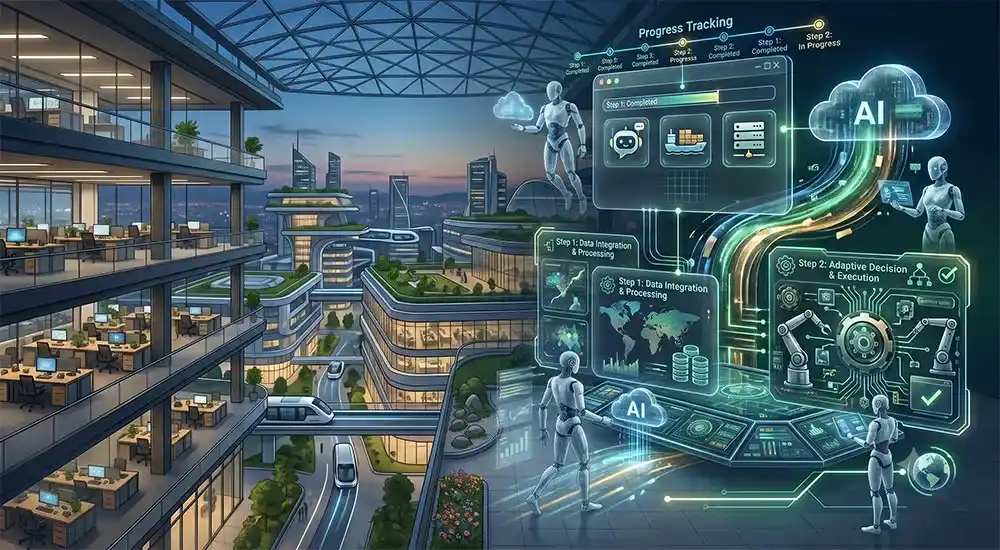
The enterprise artificial intelligence landscape has reached a monumental tipping point. What began as basic automation scripts and text-generation chatbots has matured into a sophisticated ecosystem of autonomous AI agents in business. In 2026, companies are moving beyond simple prompt-response interactions. Instead, enterprises are deploying agentic workflows where intelligent digital entities plan, reason, access software tools via APIs, execute complex multi-step tasks, and adapt to changing conditions in real time.
According to industry telemetry and market research, the global AI agents market size surpassed $10.9 billion in 2026 and is on track to cross $180 billion by 2033. Enterprise software applications are rapidly integrating agentic capabilities to handle repetitive operational burdens across sales, marketing, human resources, supply chain, finance, and customer service.
In this exhaustive 2026 guide, we explore the fundamental mechanics of agentic AI, compare legacy automation against autonomous agents, examine transformative real-world enterprise use cases, outline deployment strategies, and evaluate the future outlook of business automation.
1. What Are AI Agents? Understanding Agentic Architecture in 2026
An AI agent is an autonomous software system powered by advanced machine learning models, natural language processing (NLP), memory architecture, and decision-making logic. Unlike traditional generative tools that wait for manual user prompts, an AI agent is given a high-level goal (e.g., “Qualify incoming sales leads, verify CRM data, and schedule discovery meetings with qualified prospects”).
To accomplish this goal, the agentic architecture breaks down the overarching objective into distinct sub-tasks, determines which external tools or software APIs are required, executes those actions sequentially, evaluates the results, and adjusts its strategy if an error occurs.
The Four Pillars of Autonomous Agent Architecture
- Core Reasoning Engine (LLM/SLM): Acts as the central brain that processes natural language, evaluates context, and formulates logical multi-step action plans.
- Memory Systems (Short-Term & Long-Term): Maintains conversation context during an active session while storing historical interactions, enterprise knowledge graphs, and user preferences in vector databases.
- Tool Integration & API Connectivity: Enables the agent to interact with external enterprise environments—such as updating Salesforce records, querying SQL databases, sending emails, or triggering webhooks.
- Reflection & Error Correction: Self-evaluates generated code or executed tasks before sending final outputs, catching mistakes and re-planning workflows automatically.
Understanding these foundational cognitive frameworks matches structural advancements analyzed across our master report on How AI Tools Are Transforming Work, Education, and Daily Life in 2026.
2. Chatbots vs. Traditional Automation vs. Autonomous AI Agents
To appreciate why enterprise adoption of agentic AI is accelerating, it is vital to distinguish AI agents from legacy technology implementations:
| Feature / Attribute | Rule-Based Chatbots | Traditional RPA (Automation) | Autonomous AI Agents |
|---|---|---|---|
| Decision Logic | Rigid if-then trees | Fixed hardcoded scripts | Dynamic AI reasoning & planning |
| Adaptability | Breaks on unexpected inputs | Fails if UI or API shifts slightly | Self-corrects & replans actions |
| Input Handling | Pre-defined button clicks / keywords | Structured data inputs only | Unstructured text, voice, & visual data |
| System Execution | Single-turn conversations | Single predefined workflow | Multi-step tool integration via APIs |
| Operational Role | Basic FAQ answering | Repetitive data entry | Autonomous task completion & collaboration |
3. High-Impact Enterprise Use Cases for AI Agents in 2026
A. Customer Support & Concierge Experience
Customer support has shifted from basic deflection tactics to autonomous problem resolution. Modern AI support agents handle high-volume digital customer inquiries by accessing underlying backend databases, verifying customer identities, issuing refunds, modifying flight or hotel bookings, and resolving technical ticket issues without human escalation.
- 24/7 Autonomous Resolution: Resolves up to 70–80% of routine customer service inquiries in real time across digital storefronts, mobile apps, and messaging channels.
- Sentiment Analysis & Dynamic Escalation: Detects customer frustration or complex edge cases instantly, handing off structured conversation summaries to human support reps.
- Multilingual Support Scaling: Communicates fluently across dozens of languages natively without requiring localized support teams.
B. Sales Development & Lead Qualification
Sales teams spend over 40% of their working hours on administrative duties like updating CRM records, drafting initial outreach emails, and manually researching prospects. AI sales agents automate this entire pipeline:
How AI Sales Agents Drive Pipeline Efficiency
- Autonomous Lead Enrichment: Researches incoming website leads, verifies company size, funding history, and decision-maker profiles, and scores lead intent automatically.
- Hyper-Personalized Outreach: Drafts and dispatches tailored email campaigns based on real-time company news, job postings, and prospect interests.
- Calendar & CRM Synchronization: Coordinates meeting availability, schedules discovery calls, and logs every interaction directly into platforms like Salesforce or HubSpot.
Streamlining sales development workflows using specialized AI engines complements tools evaluated in our comprehensive review of the Best AI Productivity Tools in 2026.
C. IT Service Desk & DevOps Operations
In corporate IT departments, agentic workflows handle routine system administration, employee onboarding, credential management, and server monitoring.
- Automated Employee Onboarding: Provisions software licenses, sets up network security access permissions, and sends welcome kits automatically when HR updates employee records.
- Incident Response & Self-Healing Systems: Monitors server health telemetry, detects anomalous traffic spikes, isolates affected virtual containers, and alerts security teams before downtime occurs.
- Automated Password & Access Resets: Verifies employee identity securely and processes access requests without manual IT helpdesk intervention.
Securing corporate IT environments against modern digital threats matches enterprise defense frameworks analyzed in Cybersecurity Threats and Prevention Strategies in 2026.
D. Supply Chain, Logistics & Inventory Orchestration
Managing complex multi-node supply chains involves handling unpredictable weather disruptions, port delays, customs paperwork, and inventory shortages. AI agents act as intelligent control towers across global shipping networks.
Agentic Supply Chain Optimization Use Cases
- Dynamic Route Optimization: Monitors traffic, maritime conditions, and fuel prices in real time, automatically rerouting delivery fleets to bypass congestion.
- Automated Procurement & Inventory Reordering: Tracks warehouse stock levels and triggers reorders with preferred vendors when safety stock thresholds are crossed.
- Customs & Shipping Compliance Analysis: Parses shipping manifests, verifies international import regulations, and highlights compliance discrepancies before shipments leave port.
This level of real-time multi-node logistics processing relies on telemetry capabilities shared with hardware systems analyzed in How Technology Is Transforming Sports in 2026.
E. Finance, Accounting & Fraud Detection
Financial institutions and corporate finance teams deploy AI agents for real-time risk assessment, compliance reporting, and transaction auditing.
- Real-Time Fraud Prevention: Analyzes millions of banking transactions per second, identifying anomalous behavioral patterns and blocking fraudulent charges instantly.
- Automated Invoice Processing & Matching: Extracts invoice data, matches purchase orders against receiving logs, verifies tax details, and queues approved invoices for payment.
- Audit & Regulatory Compliance Reporting: Compiles audit-ready financial statements and verifies adherence to changing regional tax codes automatically.
4. Leading Enterprise Platforms for AI Agents in 2026
Major technology vendors have built robust platforms to simplify the building, monitoring, and scaling of business AI agents:
| Platform Name | Primary Target Focus | Key Features & Integrations | Best For |
|---|---|---|---|
| Salesforce Agentforce | CRM, Sales, & Service | Native Data Cloud access, autonomous CRM actions, & workflow triggers | Enterprise Sales & Support teams |
| Microsoft Copilot & AutoGen | Workplace & Multi-Agent Coding | Deep M365 suite integration, Teams automation, & developer multi-agent frameworks | Corporate operations & Software teams |
| HubSpot Breeze AI | Inbound Marketing & Sales | Prospecting agents, automated lead scoring, & social content creation | SMBs & Growth Marketing agencies |
| Google Cloud Vertex AI Agents | Custom Enterprise Systems | Multi-modal reasoning, enterprise data grounding, & security guardrails | Developers & Enterprise Architects |
| Zapier Central & Make.com | No-Code App Automation | Connects 6,000+ app APIs with visual multi-step decision triggers | Agencies, Operations, & Startups |
5. Step-by-Step Implementation Framework for Businesses
Deploying AI agents successfully requires a methodical, human-in-the-loop strategy to ensure data security, operational accuracy, and positive employee adoption.
- Identify Friction-Heavy Workflows: Conduct a process audit to locate repetitive operational tasks where teams spend hours on manual data entry, email coordination, or ticket triage.
- Establish Strict Data & Security Boundaries: Connect AI agents only to necessary enterprise databases using role-based access control (RBAC), zero-trust architecture, and strict API rate limits.
- Build Guided “Human-in-the-Loop” Prototypes: Start with guided workflows where the AI agent drafts actions, requiring human approval before sending external emails, processing payments, or modifying database records.
- Monitor Telemetry & Error Metrics: Track key performance indicators (KPIs) such as resolution times, escalation rates, task accuracy, and system latency.
- Scale Gradually & Train Teams: Expand agent autonomy as confidence grows, re-skilling employees to manage, evaluate, and collaborate alongside AI digital co-workers.
Developing disciplined organizational frameworks early helps students and young professionals master essential technology skills, as highlighted in our guide on the Top Skills Students Should Learn for Future Careers in 2026.
6. Technical & Ethical Challenges Facing Agentic Deployment
While the business benefits of AI agents are immense, enterprise leaders must navigate several technical and governance hurdles:
Key Deployment Challenges to Address
- Cascading Error Loops: If an agentic workflow makes an inaccurate decision in step one, subsequent execution steps may amplify that error throughout downstream enterprise databases.
- Data Privacy & System Governance: Preventing autonomous agents from accidentally exposing sensitive customer PII or confidential company data during third-party API calls.
- Legacy Software Integration Barriers: Connecting modern LLM reasoning engines to decades-old, on-premises legacy software architecture that lacks RESTful APIs.
- Cost Management & Token Overheads: Multi-step reasoning loops generate heavy API token consumption, requiring effective cost-capping and small language model (SLM) optimization.
To learn how upcoming operating systems integrate hardware-level neural acceleration to support local AI execution safely, read our technical analysis of Windows 12 Features: Next-Gen AI OS, Design Changes & Requirements.
7. Future Outlook: The Next Decade of Autonomous Enterprise Software
As we look ahead, enterprise software will complete its transition from passive toolsets into collaborative multi-agent networks. Industry analysts predict that by 2028, over 40% of enterprise applications will feature native AI agent orchestration.
Future multi-agent ecosystems will feature specialized digital teams—where a research agent, a writing agent, a compliance agent, and an analytics agent collaborate autonomously to draft corporate strategies, execute marketing campaigns, and maintain financial compliance.
To explore forward-looking AI trends, read our detailed analysis on the Future of AI Tools: Trends and Innovations to Watch in 2026.
8. Final Thoughts
The era of AI agents in business represents far more than incremental productivity gains. It marks a fundamental redesign of enterprise software, workflow execution, and operational strategy. By taking over repetitive operational burdens, AI agents empower human workers to focus on high-value creative thinking, customer relationships, and long-term business growth.
Organizations that begin building agentic strategies, establishing secure data pipelines, and upskilling their workforce today will hold a major competitive advantage in tomorrow’s AI-driven economy.
To explore additional technology reviews, productivity tools, and time-saving workflows, check out our curated resources on Best Free Educational Tools and Apps for Students in 2026, explore flexible platforms in Top Online Learning Platforms for Students in 2026, or organize personal schedules using Time Management Strategies Every Student Should Know.
Frequently Asked Questions (FAQs)
What are AI agents in business?
AI agents in business are autonomous software systems that combine machine learning, natural language processing, and decision-making logic to execute multi-step workflows, interact with enterprise databases, and achieve specific business goals with minimal human intervention.
How do AI agents differ from traditional chatbots?
Traditional chatbots rely on rigid if-then scripts to respond to pre-defined user inputs. AI agents possess reasoning capabilities, memory persistence, tool access (APIs), and multi-step planning, allowing them to autonomously execute actions across different software systems to complete tasks.
What are the primary use cases for AI agents in enterprise environments?
Key enterprise use cases include autonomous customer support resolution, lead qualification and automated sales prospecting, IT service desk automation, fraud detection in finance, supply chain orchestration, and legal contract analysis.
What is the projected market size for AI agents in 2026?
The global AI agents market size surpassed $10.9 billion in 2026 and is projected to expand rapidly toward over $180 billion by 2033, registering a compound annual growth rate (CAGR) approaching 49.6%.









Comments (0)