Top 10 Emerging Technologies Shaping the Future in 2026
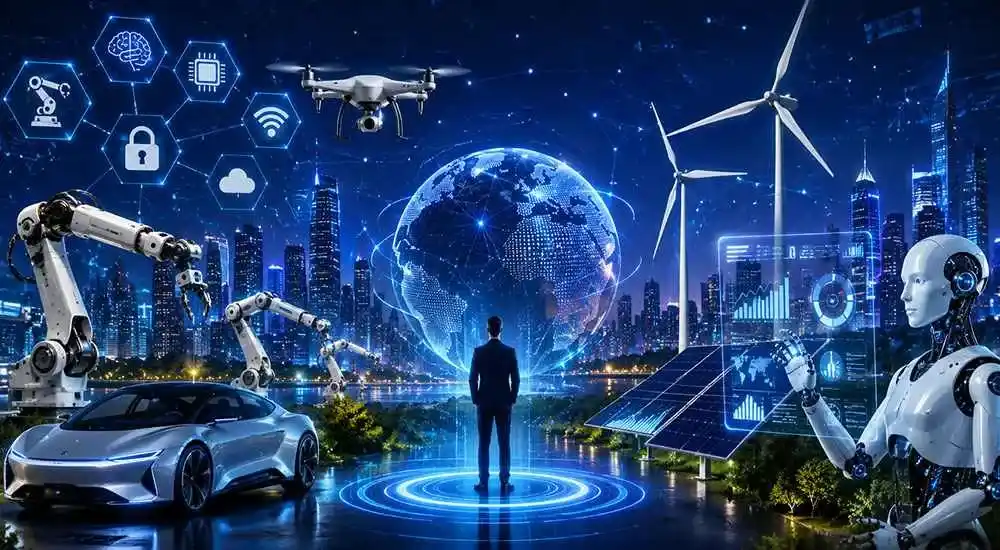
Which technologies are genuinely changing how people live and work—and which are still experiments? The answer matters more than an impressive demonstration. Artificial intelligence, robotics, quantum research, biotechnology and new security methods are progressing at different speeds.
This beginner-friendly guide explains ten important emerging technologies in 2026, what they do, where they are useful, and what limits their adoption. It separates products already used in everyday work from technologies that still need years of research.
What Are Emerging Technologies?
Emerging technologies are new or rapidly evolving tools and scientific approaches that could significantly change existing processes. Some are already commercial, while others are in laboratories or pilot programs. An emerging technology does not automatically become the dominant solution.
Top 10 Emerging Technologies to Watch in 2026
1. Artificial Intelligence and AI Agents
AI systems can summarize information, generate content, recognize patterns and assist with multi-step work. AI agents can use tools and follow instructions, but they still need supervision.
Practical applications
Customer support triage, document analysis, software assistance and internal knowledge search.
What to watch out for
Incorrect answers, privacy risks, bias and the need for human review.
Where it stands: Widely deployed for selected tasks; agent autonomy remains uneven.
2. Physical AI and Robotics
Robots combine sensors, motors, control software and increasingly machine-learning models to interact with the physical world. Humanoid demonstrations are promising, but general-purpose reliability remains difficult.
Practical applications
Warehouse movement, industrial inspection, agriculture and repetitive manufacturing work.
What to watch out for
Safety, cost, dexterity and operation in unpredictable settings.
Where it stands: Established in structured settings; flexible humanoid applications are emerging.
3. Quantum Computing
Quantum computers use qubits and quantum operations. They may offer advantages for particular problems, but they are not universally faster than classical computers. Many useful applications still require research and error correction.
Practical applications
Research in chemistry, materials and selected optimization or simulation methods.
What to watch out for
Noise, error correction, hardware scale and uncertain practical advantage.
Where it stands: Research systems and specialized cloud access; broad utility is not established.
4. Post-Quantum Cryptography
Post-quantum cryptography uses algorithms designed to resist attacks from future sufficiently capable quantum computers. Unlike quantum computing, these methods run on conventional computers.
Practical applications
Protecting long-lived records, secure websites, software updates and government systems.
What to watch out for
Migration planning, compatibility, performance and cryptographic inventory.
Where it stands: Standardization underway and migration efforts in progress.
5. Brain-Computer Interfaces
Brain-computer interfaces translate patterns of brain activity into signals that can control software or assistive devices. Research includes implanted and non-invasive approaches.
Practical applications
Communication assistance and experimental control of cursors or robotic devices.
What to watch out for
Surgery risks for implants, signal stability, training, privacy and access.
Where it stands: Clinical research and limited specialized use.
6. Spatial Computing and Extended Reality
Spatial computing blends digital information with the physical environment using cameras, sensors, displays and tracking. Augmented and virtual reality support different levels of immersion.
Practical applications
Industrial training, design review, education and remote collaboration.
What to watch out for
Device comfort, cost, content quality and motion sickness.
Where it stands: Commercial products exist; adoption varies by use case.
7. Edge Computing and Advanced Connectivity
Edge computing processes some data near its source, reducing reliance on distant cloud servers. 5G can support connected applications, but performance depends on coverage and network design.
Practical applications
Factory monitoring, video analysis, connected transport and low-latency services.
What to watch out for
Infrastructure cost, security and integration with cloud systems.
Where it stands: Deployed in many sectors; advanced use cases continue to expand.
8. Biotechnology and Gene Editing
Tools such as CRISPR enable researchers to modify genetic material, while AI-assisted research supports biological analysis. Applications require careful testing and regulatory review.
Practical applications
Selected therapies, diagnostics, agricultural research and drug discovery.
What to watch out for
Safety, ethical oversight, affordability and unequal access.
Where it stands: Research through approved treatments, depending on application.
9. Energy Storage and Clean-Energy Technology
Battery research, power electronics and smarter electricity grids aim to improve energy reliability and integration of renewable generation. No single technology solves every storage need.
Practical applications
Electric vehicles, grid storage, industrial energy management and distributed power.
What to watch out for
Materials, supply chains, lifecycle impacts and cost.
Where it stands: Commercial deployments alongside ongoing materials research.
10. Privacy-Preserving Computing and Verifiable Systems
Techniques such as zero-knowledge proofs, secure multiparty computation and confidential computing can help verify or process information while limiting unnecessary exposure.
Practical applications
Identity checks, sensitive analytics and selected financial or enterprise workflows.
What to watch out for
Implementation complexity, trust assumptions and regulatory requirements.
Where it stands: Some production uses; wider adoption is application-specific.
Emerging Technologies Comparison: Uses and Maturity
| Technology | Potential use | Current maturity |
|---|---|---|
| Artificial Intelligence and AI Agents | Customer support triage | Widely deployed for selected tasks; agent autonomy remains uneven. |
| Physical AI and Robotics | Warehouse movement | Established in structured settings; flexible humanoid applications are emerging. |
| Quantum Computing | Research in chemistry | Research systems and specialized cloud access; broad utility is not established. |
| Post-Quantum Cryptography | Protecting long-lived records | Standardization underway and migration efforts in progress. |
| Brain-Computer Interfaces | Communication assistance and experimental control of cursors or robotic devices | Clinical research and limited specialized use. |
| Spatial Computing and Extended Reality | Industrial training | Commercial products exist; adoption varies by use case. |
| Edge Computing and Advanced Connectivity | Factory monitoring | Deployed in many sectors; advanced use cases continue to expand. |
| Biotechnology and Gene Editing | Selected therapies | Research through approved treatments, depending on application. |
| Energy Storage and Clean-Energy Technology | Electric vehicles | Commercial deployments alongside ongoing materials research. |
| Privacy-Preserving Computing and Verifiable Systems | Identity checks | Some production uses; wider adoption is application-specific. |
Which Technologies Matter Most for Different Industries?
| Industry | Technologies worth evaluating | Practical first step |
|---|---|---|
| Small businesses | AI assistance, secure cloud workflows | Pilot one repetitive administrative task |
| Manufacturing | Robotics, edge monitoring, energy systems | Measure downtime or quality before buying equipment |
| Healthcare | Assistive interfaces, AI analysis, biotechnology | Start with validated tools and regulatory review |
| Education | AI learning support, spatial training | Test accessibility and learning outcomes |
| Finance | Post-quantum security, privacy-preserving systems | Inventory sensitive data and encryption dependencies |
How to Tell Real Innovation from Technology Hype
Before adopting a new technology, check whether the claimed result comes from a controlled demo, a small pilot or routine production use. Ask about independent testing, operating costs, failure rates, security and the skills required to maintain it.
- Look for measurable outcomes: Compare time saved, quality, reliability or energy used against an existing process.
- Check deployment conditions: A robot that works in a controlled warehouse may not work in a busy public space.
- Understand the trade-offs: Faster processing can introduce cost, privacy or energy demands.
- Separate forecasts from evidence: A predicted breakthrough is not a commercially available product.
A Practical Five-Step Technology Adoption Checklist
- Define a specific problem and a baseline measurement.
- Identify one technology that directly addresses the problem.
- Check security, privacy, accessibility and legal requirements.
- Run a limited pilot with clear success and stop criteria.
- Review results with the people who will use and maintain the system.
What Skills Will Be Valuable as Technology Changes?
Foundational skills often transfer across tools: data literacy, cybersecurity awareness, basic automation, critical thinking, communication and understanding how to test claims. Students can build small projects; professionals can document a process and evaluate where automation genuinely helps.
Useful Resources for Further Reading
- NIST: Post-Quantum Cryptography
- International Telecommunication Union
- International Energy Agency
- Nature: Quantum Computing Research
For related explanations, read our guides to 5G internet speed, quantum computing applications and cybersecurity threats and prevention.
Conclusion: What Will Shape the Future?
The future is unlikely to be dominated by one invention. More often, progress comes from combining useful tools: AI with robotics, connectivity with edge computing, and digital services with stronger security. Businesses and individuals can prepare by understanding the limitations as well as the possibilities, testing small use cases and learning adaptable skills.
Frequently Asked Questions (FAQs)
What are emerging technologies in simple words?
Emerging technologies are new or fast-developing tools that may change how people work and live. Some are available today, while others remain in research.
Which emerging technology is most useful for businesses today?
It depends on the business. AI assistance, workflow automation, cybersecurity tools and data analytics often offer practical starting points, but results must be tested.
Will quantum computers replace ordinary computers?
No. Quantum computers are designed for particular classes of problems and are not general replacements for laptops, phones or classical servers.
Are humanoid robots widely used in 2026?
Robots are widely used in structured industrial environments, but general-purpose humanoid robots still face significant reliability and cost challenges.
What is the difference between AI and physical AI?
AI is software that performs tasks such as prediction or content generation. Physical AI applies intelligent systems to machines that sense and act in the real world.
Why is post-quantum cryptography important?
It helps organizations prepare encryption and digital signatures for potential attacks by future powerful quantum computers.
How can students prepare for future technologies?
Learn computing basics, data literacy, security and problem-solving, then build small projects and evaluate real-world results.
Can we predict which technology will dominate the future?
Not with certainty. Adoption depends on cost, safety, regulation, infrastructure, user needs and whether a technology performs reliably outside demonstrations.








Comments (0)